

How Much Does a Small Business Website Cost? A Practical Breakdown
You have a business idea, a service to promote, or an existing company that has outgrown its old website.
Then you ask the question that seems simple:
How much does a small business website cost?
The frustrating answer is that you will probably see everything from a few hundred dollars to tens of thousands.
That does not necessarily mean someone is overcharging you.
It usually means you are comparing different things under the same label: "a website."
A five-page brochure website, a five-page WordPress site with custom functionality, and a five-page ecommerce store may all have five pages, but they are completely different projects.
So instead of starting with a price tag, let's look at what you are actually paying for.
What does a small business website actually include?
Imagine a local business owner preparing to launch a new company website.
They initially think they need five pages:
- Home
- About
- Services
- Blog
- Contact
At first, the project sounds straightforward.
Then the questions begin.
Who writes the content?
Who creates the design?
Will the website work properly on phones?
Who sets up the domain?
Where will the website be hosted?
Will the owner be able to edit pages later?
What about contact forms?
What about Google indexing and basic SEO?
Who handles security updates?
And what happens if something breaks six months after launch?
This is where many first-time website owners get confused.
The number of pages is only one part of the cost.
The work behind those pages is what determines the price.
How much does a 5-page business website cost?
There is no single global price for a five-page website.
Published 2026 pricing guides show wide ranges depending on whether the site is built by the owner, a freelancer, a studio, or an agency. One current guide puts freelancer-built small business sites around $1,500–$8,000, while agency work can run roughly $6,000–$35,000+ depending on scope. These are published market ranges rather than audited averages.
In Saudi Arabia, published 2026 guides also show a wide spread. For example, current guides place five-to-eight-page business websites anywhere from roughly SAR 3,500 to SAR 20,000, depending on design, language, functionality, and provider.
That difference is important.
It means you should not ask only:
"How much does a five-page website cost?"
A better question is:
"What work is included in the five-page website I'm being quoted for?"
Two companies can quote very different amounts, and both can be reasonable if their scopes are different.
The four main ways to build a small business website
Once our hypothetical business owner understands that, there are four realistic paths.
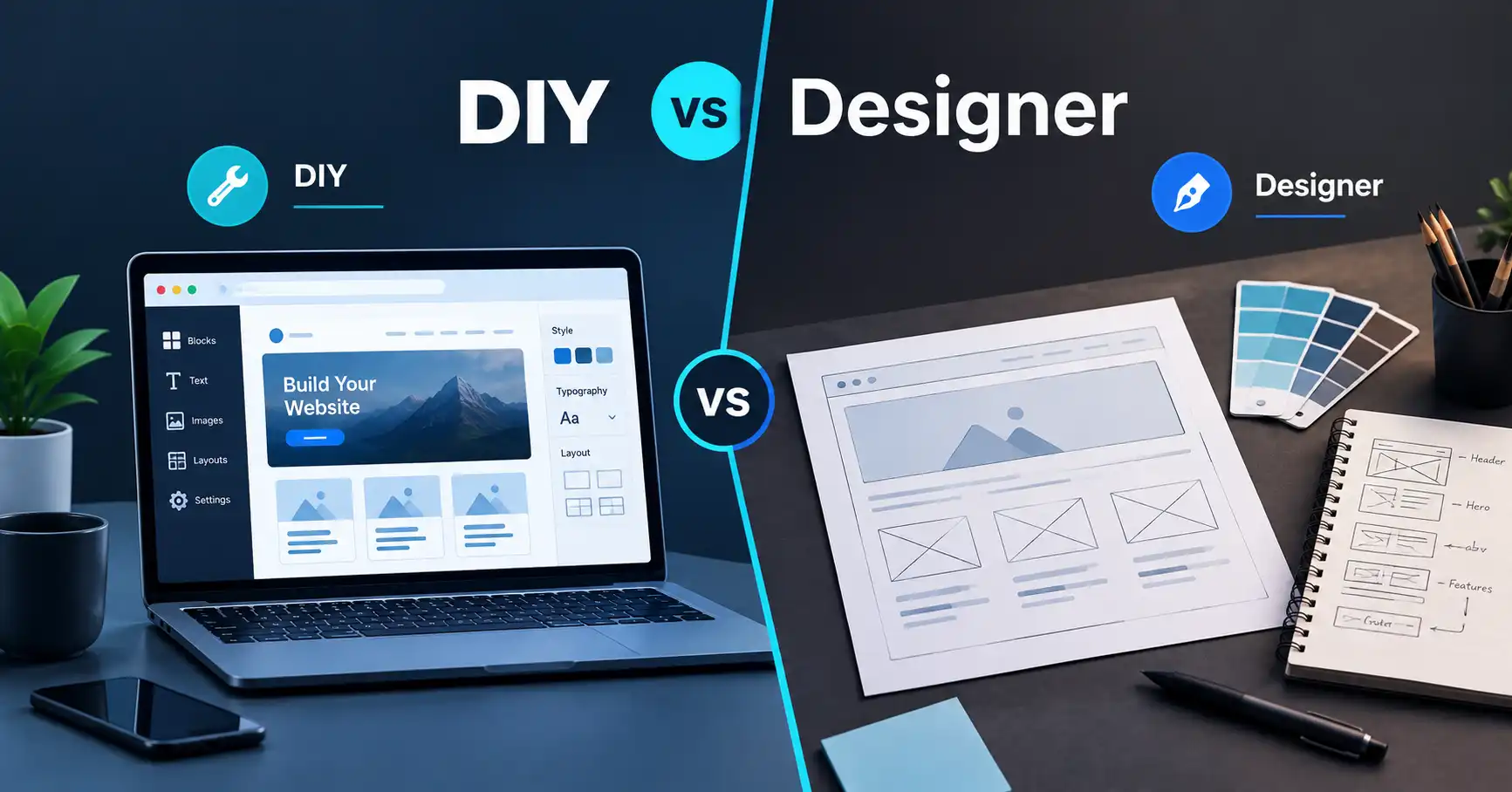
1. Build the website yourself
The cheapest option is usually to do the work yourself.
You may use WordPress, a website builder, or another DIY platform.
Your direct expenses might include:
- Domain registration
- Hosting or a website-builder subscription
- Premium themes or plugins, if needed
- Business email
- Stock images or other content
- Optional tools and services
The financial cost can be relatively low.
But there is another cost that is easy to overlook:
your time.
If you spend several weekends learning layouts, fixing mobile spacing, configuring forms, troubleshooting plugins, writing content, and figuring out why Google is not indexing a page, you are paying with time rather than money.
DIY can make sense when you have the time, enjoy learning, and have relatively straightforward requirements.
It becomes less attractive when the website itself is supposed to support a business that needs your attention elsewhere.
2. Use an AI website builder
AI website builders have changed the starting point for small business websites.
Instead of designing every section manually, you can describe the business and let the platform generate an initial structure.
That can reduce the amount of technical work required from a beginner.
But an AI-generated starting point is not automatically a finished business website.
You still need to check:
- Whether the content accurately represents the business
- Whether the design matches the brand
- Whether the pages make sense to customers
- Whether forms work
- Whether the mobile version is usable
- Whether important SEO settings are configured
- Whether images are appropriate and optimized
- Whether the platform gives you the control you need later
Think of AI as reducing some of the work involved in creating the first version.
It does not remove the need for planning and review.
If your main goal is to build a website yourself with AI assistance, an AI website-builder resource may be more relevant than hiring a development team.
3. Build it with WordPress
WordPress sits somewhere between DIY and professional development.
You can install WordPress, choose a theme or builder, add plugins, create pages, and manage the website yourself.
This can be a powerful approach because the platform supports a very wide range of business requirements.
But flexibility creates responsibility.
You have to think about:
- Hosting
- Themes
- Plugins
- Updates
- Backups
- Security
- Performance
- Compatibility
- SEO
- Content management
A beginner may install WordPress expecting the website to be "finished."
It isn't.
Installing WordPress is closer to preparing the workshop than completing the project.
The final quality still depends on how the website is planned, designed, configured, tested, and maintained.
4. Hire a professional web designer or developer
This is where the project cost can increase substantially, but the scope can also become much broader.
You are not simply paying someone to "make five pages."
You may be paying for:
- Website planning
- Information architecture
- User experience
- Custom design
- Responsive layouts
- Development
- CMS configuration
- Forms and integrations
- SEO foundations
- Performance optimization
- Security configuration
- Testing
- Launch assistance
- Training or handover
- Ongoing maintenance
This distinction explains why professional website development can cost thousands rather than hundreds.
The professional is solving a larger problem.
What actually determines the cost of a small business website?
Let's return to our business owner.
They have five pages.
Another business also has five pages.
Why could their quotes be completely different?
Design complexity
A website using an existing theme with minor customization requires different work from a website designed specifically around a company's brand.
Custom layouts, animations, interactions, illustrations, and carefully designed components can all increase development time.
Content
Someone has to create the words and images.
If the business supplies finished copy and professional photography, the project may move differently than one where the developer is expected to help structure, rewrite, format, and source content.
Functionality
A basic contact form is relatively straightforward.
A booking system, customer portal, quote calculator, membership area, CRM integration, payment system, or custom dashboard is a different class of project.
This is why page count alone is a poor way to estimate website development cost.
Mobile responsiveness
A website is not finished because it looks good on a desktop monitor.
The developer needs to consider phones and tablets as well.
That means checking layouts, typography, navigation, buttons, forms, images, spacing, and content behavior at different screen sizes.
SEO foundations
Basic SEO is not simply adding keywords to five pages.
A properly planned website may need appropriate page titles, descriptions, headings, URLs, internal links, indexing controls, structured data where appropriate, image optimization, and a logical site structure.
SEO work can therefore affect both the planning and development process.
Performance
Large images, unnecessary scripts, poorly configured plugins, excessive animations, and inefficient hosting can all affect performance.
Performance should be considered during development rather than treated as an emergency repair after launch.
Integrations
This is another major cost driver.
Consider the difference between:
"Send me an email when someone submits this form."
and:
"Send the lead to our CRM, assign it to a salesperson, send a confirmation email, notify our team, and store the submission in our dashboard."
They may both be described as a "contact form."
They are not the same project.
What does a small business website cost beyond the initial build?
One common mistake is budgeting only for development.
A website can have ongoing expenses.
These may include:
- Domain renewal
- Hosting
- Business email
- Premium plugins or software
- Security services
- Backups
- Maintenance
- Content updates
- SEO work
- Technical support
Hosting itself can range considerably depending on the type of service. Current Saudi-focused 2026 guides, for example, show entry-level shared hosting in the tens of riyals per month, with VPS and other higher-capacity options costing considerably more.
You therefore need to separate build cost from running cost.
A website that costs less to build is not automatically cheaper over several years.
Why a cheap website quote can become expensive
Suppose someone offers to build your website for a surprisingly low price.
Before celebrating, ask what is actually included.
Is the design custom?
Who supplies the content?
Are revisions included?
Is mobile optimization included?
Is WordPress configured?
Are forms included?
Who owns the domain?
Who owns the hosting account?
Are backups configured?
Is basic SEO included?
Is the website tested before launch?
Will someone help if the website breaks?
Are future changes included?
There is nothing inherently wrong with a low-cost website.
A simple website can genuinely be inexpensive.
The problem comes when the low price is achieved by removing work that you assumed was included.
A useful quote should make the scope visible.
How to compare website quotes properly
Imagine you receive three proposals.
One says:
Website — $1,500
Another says:
Business Website — $4,000
The third says:
Custom Business Website — $8,000
Those numbers tell you almost nothing by themselves.
Instead, create a comparison based on scope.
Look at:
| Area | What to ask |
|---|---|
| Pages | How many pages are included? |
| Design | Template, customized theme, or custom design? |
| Content | Who writes and prepares the content? |
| Mobile | Is responsive design included? |
| CMS | Can you edit the website yourself? |
| SEO | What SEO foundations are included? |
| Forms | What forms and notifications are included? |
| Integrations | Are third-party systems connected? |
| Performance | Is optimization included? |
| Security | What security configuration is included? |
| Testing | Is pre-launch testing included? |
| Launch | Who handles deployment and configuration? |
| Training | Will you be shown how to manage the site? |
| Maintenance | What happens after launch? |
Now you are comparing projects rather than numbers.
So, what should you budget for?
If you only need a simple online presence and are comfortable doing the work yourself, a DIY approach can keep the initial financial cost relatively low.
If you want professional design and development, published 2026 market guides commonly place small-business projects in the thousands rather than hundreds of dollars, with the exact figure depending heavily on scope.
For businesses in Saudi Arabia, current published guides show professional small-business website ranges that can span from several thousand riyals into the tens of thousands, again depending on requirements.
The important point is not to treat any one range as a universal "correct" price.
Instead, use it as a budgeting reference.
A straightforward five-page information website is one thing.
A bilingual website with custom design, SEO foundations, booking, CRM integration, advanced forms, and ongoing support is something else.
When does hiring a professional make sense?
This is the question behind the price question.
If you enjoy building websites and have enough time to learn, DIY may be perfectly reasonable.
If you specifically want to experiment with AI website creation, an AI builder may be appropriate.
If you need a flexible content-managed website, WordPress may be worth considering.
But professional development becomes more relevant when the website is an important business asset and you need someone to handle planning, design, development, integrations, performance, technical setup, or ongoing support.
The decision is not simply:
"Can I build a website myself?"
It is:
"How much of the website-building process do I want to own myself, and how much do I want handled professionally?"
That is a much more useful question.
What should you ask before accepting a website quote?
Before signing anything, ask for a written scope.
At minimum, you should understand:
- Exactly which pages are included.
- What functionality is included.
- Who provides the content.
- Whether the design is custom or template-based.
- Whether mobile optimization is included.
- Whether SEO foundations are included.
- Who owns the domain and hosting accounts.
- What happens after launch.
- How revisions are handled.
- What costs continue after the initial project.
If the answers are vague, the price comparison will be vague too.
A professional proposal should make it easier to understand what you are buying.
The practical takeaway
There is no universal price for a small business website.
A DIY website may mainly cost you software, hosting, and your time.
An AI builder can reduce some of the work while still requiring human planning and review.
WordPress can provide considerable flexibility but also requires decisions about hosting, themes, plugins, security, performance, and maintenance.
Professional development costs more because you are paying for planning, design, technical implementation, testing, and problem-solving rather than simply having someone place five pages online.
So if you are trying to calculate your small business website cost, don't start with the number.
Start with the scope.
Define what the website needs to accomplish, which pages and functions it requires, who will provide the content, how it will be maintained, and what technical work is expected.
Once those questions are answered, the price becomes much easier to understand.
And if you reach the point where you would rather have the planning, design, development, and technical setup handled professionally, that is when it makes sense to speak with a web development team rather than comparing website prices based only on page count.
FAQs
How much does a 5-page business website cost?
There is no universal price. Published 2026 guides show professional five-to-eight-page business websites ranging from several thousand dollars to substantially more, depending on design, development, content, functionality, and provider type. In Saudi Arabia, published guides similarly show several-thousand-riyal to tens-of-thousands-of-riyal ranges.
How much does it cost to build a small business website yourself?
DIY costs can be relatively low because you are primarily paying for the domain, hosting or builder subscription, and any premium tools you choose. However, your time is also part of the real cost.
Is WordPress cheaper than hiring a web developer?
It can be, particularly if you build and maintain the website yourself. But WordPress does not eliminate the cost of design, development, content, hosting, plugins, maintenance, or technical support. The comparison depends on what work you are doing yourself.
Is an AI website builder cheaper than professional web development?
An AI website builder can reduce the amount of hands-on work required to create an initial website. Professional development can cost more because it can include planning, custom design, development, integrations, testing, performance work, and technical support.
Why do two five-page websites have completely different prices?
Because page count does not describe the whole project. Custom design, content creation, responsive development, SEO, integrations, multilingual requirements, booking systems, ecommerce, performance, and maintenance can all change the amount of work involved.
What should be included in a professional website quote?
At minimum, the proposal should clearly explain the pages, design approach, functionality, content responsibilities, responsive behavior, SEO foundations, integrations, testing, launch process, revisions, ownership, and post-launch support.
8. Service / Monetization Bridge
For a business that needs more than a basic DIY website, the next logical step is professional planning and development. A web development team can help define the site structure, design the user experience, build the website, configure the technical foundations, test it, and prepare it for launch.
If you want those responsibilities handled professionally, the relevant next step is the PlanYourHost contact page: PlanYourHost Contact
Editors Pick
Divi 5 review and website-building considerations → Divi 5 Review 2026
Share this article 👇